




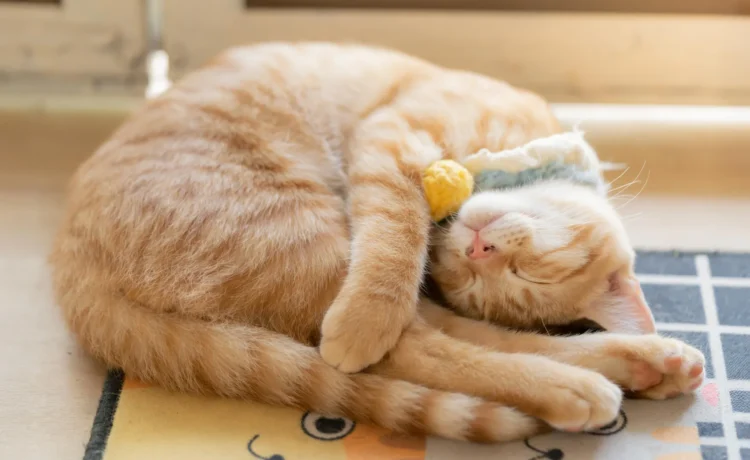
Cats prefer to sleep on their left side. This is the conclusion drawn by an international research team that analyzed several hundred YouTube videos of sleeping cats. The researchers see this bias as an evolutionary advantage because it favors hunting and escape behavior after waking up. The team from the University of Bari Aldo Moro (Italy), Ruhr University Bochum, Medical School Hamburg and other partners in Germany, Canada, Switzerland and Turkey report on the study in the journal Current Biology, published online on June 23, 2025.
All animals are particularly vulnerable while sleeping. Cats sleep around 12 to 16 hours a day, preferably in elevated places where their predators can only access them from below. The research team around Dr. Sevim Isparta from the Animal Physiology and Behaviour Research Unit in Bari and Professor Onur Güntürkün from the Bochum working group Biopsychology wanted to find out whether cats prefer to sleep on one side or the other. “Asymmetries in behavior can have advantages because both hemispheres of the brain specialize in different tasks,” says Onur Güntürkün.
Perceiving dangers with the left visual field brings advantages
The group analyzed 408 publicly available YouTube videos in which a single cat was clearly visible with its entire body sleeping on one side for at least ten seconds. Only original videos were used; modified or flipped material was excluded from the study. Two thirds of the videos showed cats sleeping on their left side.
The explanation: Cats that sleep on their left side perceive their surroundings upon awakening with their left visual field, which is processed in the right hemisphere of the brain. This hemisphere is specialized in spatial awareness, the processing of threats and the coordination of rapid escape movements. If a cat sleeps on its left shoulder and wakes up, visual information about predators or prey goes directly to the right hemisphere of the brain, which is best in processing them. “Sleeping on the left side can therefore be a survival strategy,” the researchers conclude.
Cooperation partners
- University of Bari Aldo Moro (Italy)
- Ruhr University Bochum (Germany)
- Medical School Hamburg (Germany)
- Research Institute for Farm Animal Biology (Germany)
- University of Prince Edward Island (Canada)
- Kafkas University (Turkey)
- Federal Food Safety and Veterinary Office (Switzerland)


NASA Curiosity rover finds mysterious life linked molecules on Mars
NASA's Curiosity rover has identified a wide range of organic molecules on Mars, including compounds that scientists consider key ingredients...

Scientists just discovered Africa is closer to breaking apart than we thought
Eastern Africa's Turkana Rift is known both for its rich record of early human fossils and for intense volcanic activity...
Hidden virus in your gut may be linked to colon cancer
Colorectal cancer is among the most common cancers in Western countries and remains a major cause of cancer-related deaths. While...

A new force of nature is reshaping the planet, study finds
Human societies have not just adapted to the natural world. They have steadily learned how to transform it. Drawing on...


