





“There is a certain irony that a pro-school choice administration would cut objective data that might help increase acceptance of homeschooling,” said Maranto.
It is unclear what will happen to the unreleased 2023 homeschool data or if the Education Department will ever collect homeschool statistics in the future.
In response to questions about the fate of the homeschool data, Education Department spokeswoman Madison Biedermann said that its research arm, the Institute of Education Sciences, is in possession of the data and that it is “reviewing how all its contractual activities can best be used to meet its statutory obligations.”
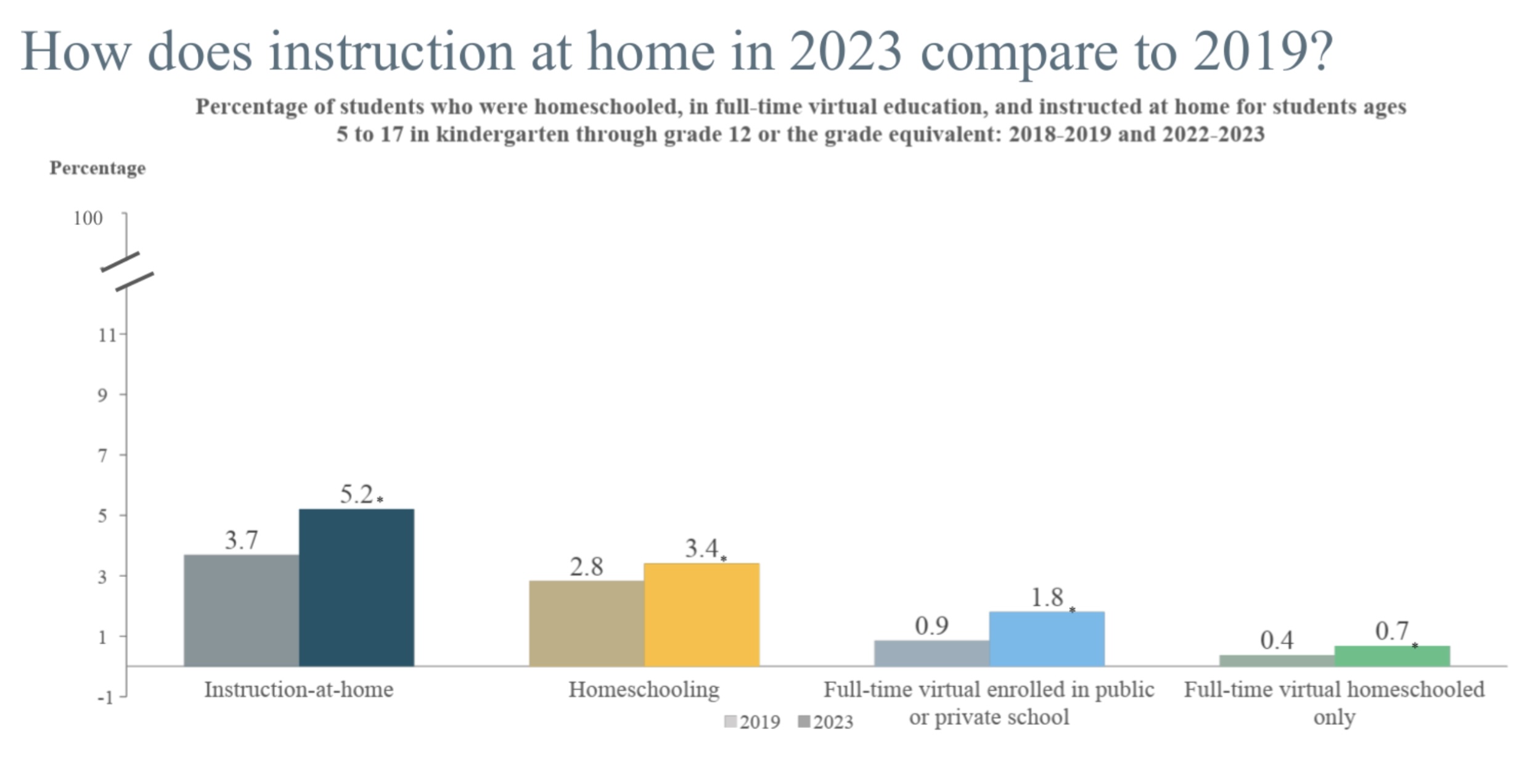
Last September, the Education Department released some preliminary statistics from the 2023 survey. It noted a small increase in traditional homeschooling since 2019 but a large increase in the number of students who were enrolled in an online virtual school and learning from home full time. Together, more than 5 percent of U.S. students were learning at home in one of these two ways. Fewer than 4 percent were learning at home in 2019.
Researchers were keen to dig into the data to understand the different flavors of homeschooling, from online courses to microschools, which are tiny schools that often operate in private homes or places of worship. Researchers also want to understand why more parents are opting for homeschooling and which subjects they are directly teaching their children, all questions that are included in the parent survey conducted by the Education Department.
Tracking homeschooling is notoriously difficult. Families who choose this option can be distrustful of government, but this was one of the few surveys that homeschool advocates cited to document the growth in their numbers and they advised the writers of the federal survey on how to phrase questions.
Beginning in 2020, the U.S. Census Bureau also began collecting some data on homeschooling, but those statistics cannot be directly compared with the Education Department data and without a historical record, the census data is less useful, researchers said. It is also unclear if this census data will continue. Some states collect data on homeschooling, but researchers said they do it in different ways, making it impossible to compare homeschooling across states.
Patrick Wolf, a professor of education policy who studies school choice at the University of Arkansas, was also dismayed by the loss of the Education Department’s statistics.
“A federal government agency has been collecting national statistics on education since 1867,” he said. “State and local policy makers and practitioners will be severely challenged in doing their work if they don’t have good data from the feds regarding public schooling, private schooling, and homeschooling. Sending education authority to the states only will work well if the federal government continues to collect and publish comprehensive data on schooling. Otherwise, state and local officials are being asked to fly blind.”
Contact staff writer Jill Barshay at 212-678-3595, jillbarshay.35 on Signal, or barshay@hechingerreport.org.
This story about the homeschool statistics was written by Jill Barshay and produced by The Hechinger Report, a nonprofit, independent news organization focused on inequality and innovation in education. Sign up for Proof Points and other Hechinger newsletters.

Schools and States Are Now Setting Limits on Screen Time for Students
The move is an about-face for a district that, since the pandemic, has focused on bringing technology into the classroom....
Feedback Bias? How AI Adjusts Replies Based on Race and Gender, Research Finds
The AI models addressed female students more affectionately and used more first-person pronouns. (“I love your confidence in expressing your...
Do You Like AI Because AI Likes You? How AI Flattery Crosses Signals
“We haven’t really had this kind of technology for very long,” she says, “and so no one really knows what...
Who Misses Out When Tutoring Starts Too Late?
Episode Transcript Marlena Jackson-Retondo: Welcome to Mind Shift, where we explore the future of learning and how we raise our...


