




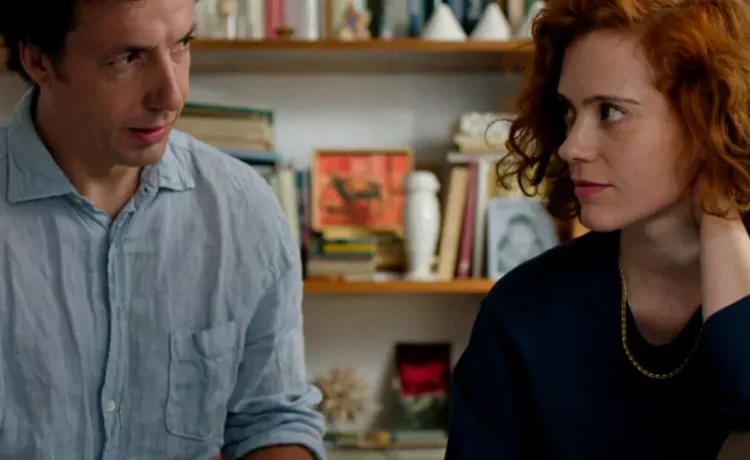

You almost can’t quite believe that someone hadn’t had this idea before: a well-to-do creative couple living in a cosy Madrid apartment decide that they want to wrap-up their 15 year relationship. Instead of being embarrassed or even saddened by the decision, they instead chose to organise a big party, on the logic that everyone celebrates union and no-one celebrates separation. And that’s massively unfair on separation.
Itsaso Arana is the comically unsentimental Ale, an independent filmmaker who refuses to let her guard down and spends the vast majority of the film with a scowl on her face as if to transmit her constant air of light annoyance at society and its antiquated precepts. Vito Sanz is Alex, her more neurotic partner who nonetheless is entirely all-in on this eccentric enterprise. The film consists of the couple individually disseminating the invite to friends and family while also fending off repeated accusations that the pair are entirely crazy for doing this. The repeated refrain is that they are wantonly destroying something beautiful.
Get more Little White Lies
And from an audience vantage, you’re inclined to agree, as from the intuitive and loving way in which they interact and make decisions together, they present as the model couple. The paradox of this decision is that no couple who truly despises one another, who feels the pressing need to pack up and move on, would be able to be so civilised when it comes to this amicable parting of ways. It’s never fully evident why the pair are breaking up; the inference also is that they too are making a choice as more of a rejection of social mores than as a pressing desire to be rid of one another.
Writer-director Jonás Trueba – son of the Oscar-winning Spanish director Fernando Trueba, who co-stars here as Ale’s crestfallen father – draws on the template of classic Hollywood comedies in which a couple in the throes of a break-up eventually rediscovers the spark that set them off in the first place (The Awful Truth, The Philadelphia Story, His Girl Friday). Yet while those films tended to focus predominantly on the actions of the central couple, The Other Way Around offers a chorus of discourse and commentary and draws humour out of the fact that everyone thinks that Alex and Ale’s decision is an implicit criticism of their own bourgeois complacency.
To add further to the meta-cinematic layering, Ale is also making a film on a similar subject, and though we never actually see it, there are scenes documenting the feedback process in which Trueba comically anticipates some of the criticisms that the audience might level at his own film, the main one being the repetitive structure of the various meetings. But things are kept light and funny enough for the momentum to keep rolling, even if the film does lose its way in the final stretch when the couple go through the domestic process of splitting up and a more straightforward will they/won’t they dynamic is introduced.
Yet in the main this is a perceptive, self-analysing delight, and you can absolutely see this being remade in the English language by a filmmaker who will definitely sand all the edges down and pull back on everything that makes Trueba’s film so unique.

The magnificent range of Marianne Jean-Baptiste
Cynthia bawls, Hortense holds herself together, at first over the phone and then in person. The camera holds mother and...

The Piano Teacher and The Limits of Desire
Romy keeps fantasising about Samuel, and it’s implied that BDSM now plays some role in her marriage. But, as in...

I’ve Seen All I Need To See review – grief in a…
Memory flickers like an old television left on too late. Images blur, and voices get lost under the crackle of...

Hey Nostradamus: Conner O’Malley’s American Dream
O’Malley’s videos feature the wild plot twists and whiplash juxtapositions of a short-attention-span culture; watching them can be as abrasive as...


