




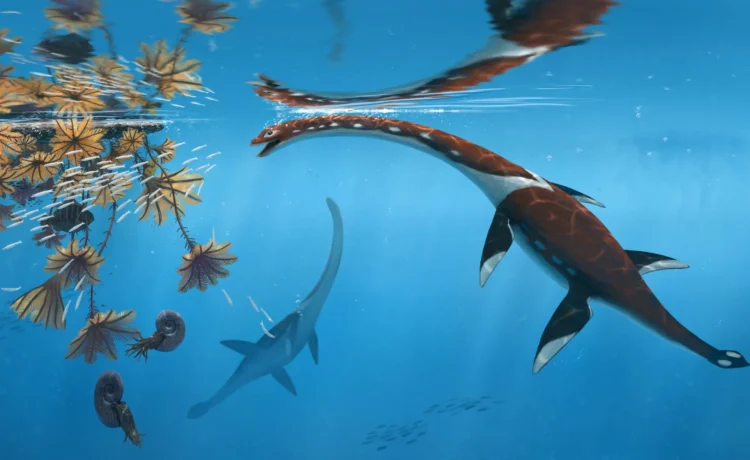
Paleontologists have identified a new species of ancient marine reptile from Germany’s world-renowned Posidonia Shale fossil beds, expanding our understanding of prehistoric ocean ecosystems that existed nearly 183 million years ago.
The newly classified species, named Plesionectes longicollum (“long-necked near-swimmer”), represents a previously unknown type of plesiosauroid — the group of long-necked marine reptiles that inhabited Earth’s oceans during the age of dinosaurs. The specimen is a nearly complete skeleton that even preserves remnants of fossilized soft tissue. It was originally excavated in 1978 from a quarry in Holzmaden, Southwest Germany, but its unique anatomical features have only now been fully recognized through comprehensive scientific analysis.
“This specimen has been in collections for decades, but previous studies never fully explored its distinctive anatomy,” said Sven Sachs of the Naturkunde-Museum Bielefeld, the study’s lead author. “Our detailed examination revealed an unusual combination of skeletal features that clearly distinguish it from all previously known plesiosaurs.”
The research, published by Sven Sachs and co-author Dr. Daniel Madzia from the Polish Academy of Sciences, demonstrates that the Posidonia Shale — already famous for its exceptionally preserved fossils — contained even greater marine reptile diversity than previously recognized.
The Plesionectes specimen is particularly significant as it represents the oldest known plesiosaur from the Holzmaden area. Despite being an immature individual, its distinctive anatomical characteristics were not significantly affected by its developmental stage, warranting classification as an entirely new genus and species.
“This discovery adds another piece to the puzzle of marine ecosystem evolution during a critical time in Earth’s history,” explained Dr. Madzia. “The early Toarcian period when this animal lived was marked by significant environmental changes, including a major oceanic anoxic event that affected marine life worldwide.”
The fossil is permanently housed at the Staatliches Museum für Naturkunde Stuttgart (Stuttgart State Museum of Natural History) where it is cataloged as specimen SMNS 51945.
The Posidonia Shale at Holzmaden has previously yielded five other plesiosaur species, including representatives from all three major plesiosaur lineages. This new addition further cements the formation’s status as one of the world’s most important windows into Jurassic marine life.


This cow uses tools like a primate—and scientists are stunned
In 1982, cartoonist Gary Larson introduced a famous Far Side comic called Cow Tools. The illustration showed a cow proudly...
Scientists discover Alzheimer’s hidden “death switch” in the brain
A team led by neurobiologist Prof. Dr. Hilmar Bading at Heidelberg University has identified a key molecular process that drives...
Huge study finds no evidence cannabis helps anxiety, depression, or PTSD
A major paper published in The Lancet reports that medicinal cannabis does not effectively treat anxiety, depression, or post-traumatic stress...

Scientists finally reveal how this Alzheimer’s drug really works
Lecanemab, marketed as Leqembi, is a monoclonal antibody treatment for Alzheimer's disease that targets and removes harmful amyloid plaques while...


