




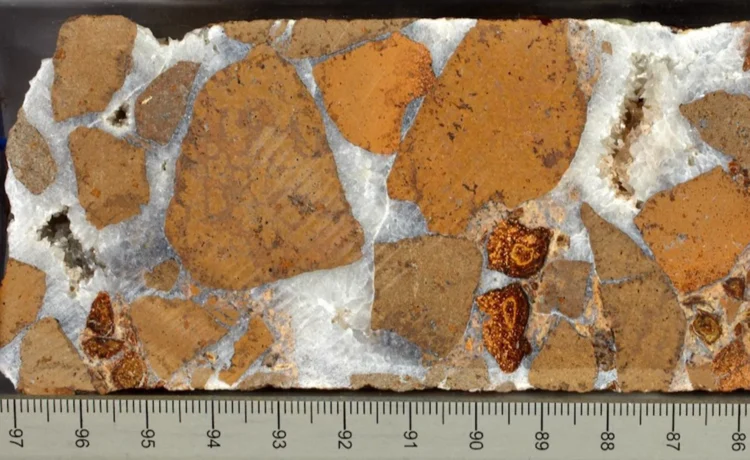
Rock samples that formed about 60 million years ago and were collected from far beneath the ocean surface have helped scientists understand how large amounts of carbon dioxide can remain locked away for extremely long periods. These samples show that CO2 becomes trapped within layers of lava rubble that build up across the seafloor.
Researchers examined lava material drilled from deep below the South Atlantic Ocean to measure how much CO2 becomes incorporated into these rocks through interactions between seawater and the cooling volcanic material.
Work led by the University of Southampton demonstrates that these accumulations of broken lava, created as underwater mountains erode, act as natural reservoirs for CO2. This study marks the first time their role as extensive carbon-holding structures has been clearly recognized, offering fresh insight into how Earth manages carbon over millions of years.
Lava Rubble as a Long-Term Geological “Sponge”
Lead author Dr. Rosalind Coggon, Royal Society Research Fellow at the University of Southampton, explained: “We’ve known for a long time that erosion on the slopes of underwater mountains produces large volumes of volcanic rubble, known as breccia — much like scree slopes on continental mountains.
“However, our drilling efforts recovered the first cores of this material after it has spent tens of millions of years being rafted across the seafloor as Earth’s tectonic plates spread apart.
“Excitingly, the cores revealed that these porous, permeable deposits have the capacity to store large volumes of seawater CO2 as they are gradually cemented by calcium carbonate minerals that form from seawater as it flows through them.”
How Carbon Moves Through Earth Over Geological Time
The amount of carbon dioxide in the atmosphere is influenced by the slow exchange of carbon among Earth’s interior, the oceans, and the air over many millions of years. Understanding this long-term carbon cycle requires studying where and how carbon is added or removed from different parts of the planet.
Dr. Coggon noted: “The oceans are paved with volcanic rocks that form at mid-ocean ridges, as the tectonic plates move apart creating new ocean crust. This volcanic activity releases CO2 from deep inside the Earth into the ocean and atmosphere.
“However, ocean basins are not just a container for seawater. Seawater flows through the cracks in the cooling lavas for millions of years and reacts with the rocks, transferring elements between the ocean and rock. This process removes CO2 from the water and stores it in minerals like calcium carbonate in the rock.”
As part of the project, the team quantified how much CO2 becomes incorporated into ocean crust through these chemical reactions.
Discovering Far Greater CO₂ Storage in Breccia
“While drilling deep into the seafloor of the South Atlantic, we discovered lava rubble that contained between two and 40 times more CO2 than previously sampled lavas,” said Dr. Coggon.
“This study revealed the importance of such breccia, which forms due to the erosion of seafloor mountains along mid-ocean ridges, as a sponge for carbon in the long-term carbon cycle.”
The findings come from Expedition 390/393 of the International Ocean Discovery Program.


Scientists say 7 days of meditation can rewire your brain
Researchers at the University of California San Diego report that a weeklong program combining meditation and other mind-body techniques can...
Binge drinking just once a month may triple your risk of liver scarring
LOS ANGELES — People may assume that if they drink lightly during the week or month, heavy drinking on the occasional Friday or Saturday may not cause...
Scientists found a baby dinosaur hidden in rock and it is surprisingly cute
In South Korea, a playful green cartoon dinosaur named Dooly, known for the two small tufts of hair on his...
This hidden state of water could explain why life exists
Researchers at Stockholm University have used advanced x-ray lasers to uncover a long-suspected feature of water: a critical point that...


