
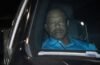





The invisible loyalties between Vinz, Hubert and Saïd suggest that they are childhood friends, splintering in young adulthood because of tensions in the neighbourhood – where the riot following the assault of their friend has laid waste to Hubert’s boxing gym – and in their disparate ways of relating to it. Vinz is a hothead, flailing against oppressive authority. Hubert, back home from the navy with a hard-won discipline and fragile maturity (‘la haine attire la haine’), dreams of escaping – his weary mother’s response is to ask him to pick up some lettuce from the shops (women have only incidental roles in the film). Saïd is the clown and little brother of the group with wisdom of his own. His jokes, told eagerly to impress Vinz but also as a means to comprehend his daily reality, hinge around violent misunderstandings. Vinz’s repeated response to these gags, ‘I heard that one with a rabbi’, is a nod from Kassovitz to the joke format as a narrative device, and the fact that the three friends are intended to be representative of the diverse neighbourhood: a Black man, an Arab and a Jew.
The tussle between childhood and adulthood in the film also recalls, in the current context of an ascendant far right, the disavowal of humanity on the basis of race. From a reactionary standpoint, Black youth can never be vulnerable, or children. We witness Hubert’s hard-bitten maturity turn to incandescent rage following an excruciating assault at the hands of sadistic plainclothes cops in Paris and, later, an encounter with a gang of skinheads (featuring a cameo from Kassovitz himself). During a contemplative interlude on a Parisian rooftop, Vinz and Hubert philosophise, trying on proverbs and mottos for size: ‘haste makes waste’, or, with scathing sarcasm, ‘Liberté, Égalité, Fraternité’. The friends may be kept out of sight on the periphery of a world city, but their situation is a symptom of, not separate from, wider society. At a crucial point as the trio kill time until the first morning train out of Paris, we see footage of the Bosnia War on a bank of TV screens. Then, their friend Abdel’s death is announced. Global disasters bleed into local crises, leading to a sense of overwhelming despair that feels all too familiar.
Saïd’s humour is echoed by Hubert in the film’s emblematic opening and closing joke-as-metaphor about a man falling from a high-rise building with the delusional refrain ‘so far, so good …’ and this unravelling finds its parallel in the decaying social contract with catastrophic consequences. The opening shot pairs a view of the earth from space with a hurtling Molotov cocktail. As the friends take the train into Paris, we realise (with a grimace from Hubert as he looks at passing billboards) that this opening image is a maddening illusion: it is an advert declaring ‘the world is yours’. Saïd later defaces one of these posters to read ‘the world is ours’. This is a mirage and false promise for young men like them, much like the motif of the cow roaming the estate that only Vinz sees: change or hope presented as an impossible chimera, out of reach. In another of the film’s more nuanced, surreal moments, the young men encounter a Polish survivor of a Soviet gulag with a story of futility, suffering and indignity that the trio struggle to understand, but that could be read most obviously as an allegory of their lose-lose situation: the question, the man notes, ‘is not if you believe in God, but if God [or, it could be extrapolated, society] believes in you’.
The film’s ending is pure, vitriolic rage on the part of Kassovitz, and, for all its shock value, an entirely plausible conclusion. It is both pessimistically determinist, consigning Vinz, Hubert and Saïd to their seemingly inevitable fate, and as searing and galvanising as the first time I saw it. There may be no sense or honour in the waste of young life around them, but there is a system of racism, classism and ignorance that the friends are grappling to understand, the better to push against.

Pompei: Below the Clouds review – a stimulating…
The inner lives of buildings and institutions provide an intriguing and enlivening way of looking at the modern landscape, particularly...

They Will Kill You review – limb-lopping cartoon…
They Will Kill You opens with a happy family gathered around a dining table. Two young sisters stand out in the dark...

Fallen Star: In Praise of The Man Who Fell To…
From there, he goes into seclusion in the dry Southwestern landscapes that likely remind him most of home, inadvertently retreating...

Ready or Not 2: Here I Come review – here comes…
When you have a hit film these days, inevitably the question always arises about a sequel. There’s very little studios love more...


