




The sun-drenched paradise of Thailand’s Phi Phi islands isn’t the usual starting point for a PhD. But for Sarah Sajedi, those soft, sandy beaches – or rather, what she found under them -inspired her pivot from a business career to an academic one.
“I was standing there looking out at this gorgeous view of the Andaman Sea, and then I looked down and beneath my feet were all these pieces of plastic, most of them water bottles,” she says.
“I’ve always had a passion for waste reduction, but I realized that this was a problem with consumption.”
Sajedi, BSc ’91, decided to return to Concordia to pursue a PhD with a focus on plastic waste. As the co-founder of ERA Environmental Management Solutions, a leading provider of environmental, health and safety software, she brought decades of experience to complement her studies.
Her latest paper, published in the Journal of Hazardous Materials, looks at the science around the health risks posed by single-use plastic water bottles. They are serious, she says, and seriously understudied.
Tiny threats, little known
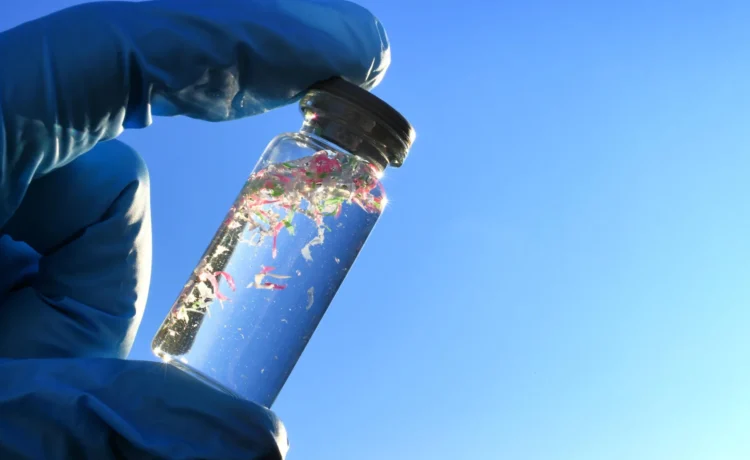
In her review of over 140 scientific articles, Sajedi writes that individuals on average ingest between 39,000 and 52,000 microplastic particles per year, and bottled water users consume 90,000 more particles than tap water consumers.
The particles are usually invisible to the naked eye. A microplastic particle can range between one micron — a thousandth of a millimeter — to five millimeters; nanoplastics are smaller than one micron.
They emerge as bottles are made, stored, transported and broken down over their lifespans. Because they are often made from low-quality plastic, they shed tiny pieces every time they are manipulated and exposed to sunlight and temperature fluctuations. And unlike other types of plastic particles, which enter human bodies through the food chain, these are ingested directly from the source.
As Sajedi notes, the health consequences can be severe. Once inside the body, these small plastics can cross biological boundaries, enter the bloodstream and reach vital organs. This can lead to chronic inflammation, oxidative stress on cells, hormonal disruption, impaired reproduction, neurological damage and various kinds of cancer. However, the long-term effects remain poorly understood due to a lack of widespread testing and standardized methods of measurement and detection.
Sajedi identifies multiple methods researchers have used to measure nano- and microplastics, each with their own strengths and weaknesses. Some, for instance, can detect very small particles but cannot identify their chemical composition. Others can provide details about their makeup but miss the smallest plastics. And the best, most advanced and most reliable tools are often extremely costly and not always available.
Education is the best prevention
Sajedi is encouraged by the legislative action that has been adopted by governments around the world aimed at limiting plastic waste. However, she notes that the most common targets are single-use plastic bags, straws and packaging. Very few address the pressing issue of single-use water bottles.
“Education is the most important action we can take,” she says. “Drinking water from plastic bottles is fine in an emergency but it is not something that should be used in daily life. People need to understand that the issue is not acute toxicity — it is chronic toxicity.”
Chunjiang An, associate professor, and Zhi Chen, professor, in the Department of Building, Civil and Environmental Engineering at the Gina Cody School of Engineering and Computer Science contributed to this paper.
This research was supported by the Natural Sciences and Engineering Research Council of Canada and Concordia University.


Scientists say 7 days of meditation can rewire your brain
Researchers at the University of California San Diego report that a weeklong program combining meditation and other mind-body techniques can...
Binge drinking just once a month may triple your risk of liver scarring
LOS ANGELES — People may assume that if they drink lightly during the week or month, heavy drinking on the occasional Friday or Saturday may not cause...

Scientists found a baby dinosaur hidden in rock and it is surprisingly cute
In South Korea, a playful green cartoon dinosaur named Dooly, known for the two small tufts of hair on his...
This hidden state of water could explain why life exists
Researchers at Stockholm University have used advanced x-ray lasers to uncover a long-suspected feature of water: a critical point that...


