




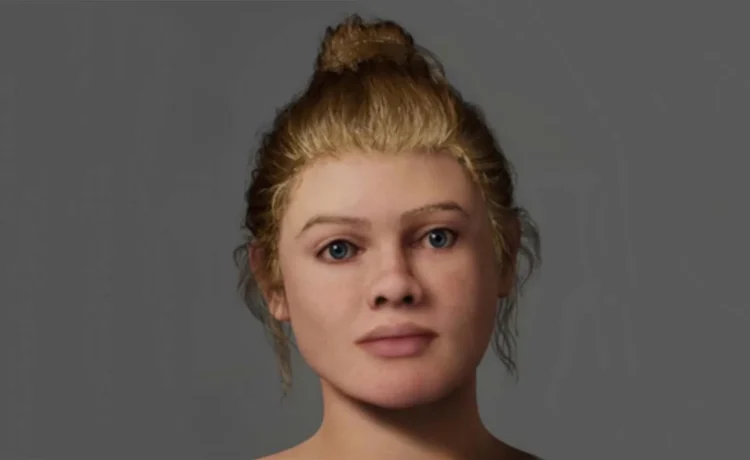
A long-standing mystery surrounding a Roman-era skeleton discovered in southern England may finally be close to an answer.
Earlier studies suggested the young woman, known as the Beachy Head Woman, may have had recent ancestry from sub-Saharan Africa or the Mediterranean. New genetic research now points in a different direction, indicating she was most likely from Britain.
Using advanced DNA sequencing, researchers aimed to resolve questions that have surrounded the Beachy Head Woman for more than a decade.
A Skeleton Found in a Basement
The remains were rediscovered in 2012 during the Eastbourne Ancestors Project, when a box was opened in the basement of Eastbourne Town Hall. Inside was the skeleton of a young woman from the Roman era. A handwritten label indicated she had been found near the Beachy Head headland sometime in the 1950s, but little additional information was available.
Public attention grew after early research suggested the woman may have had recent sub-Saharan African ancestry. If correct, the skeleton would have represented rare early evidence of African ancestry in Roman Britain.
Later, unpublished research proposed a different origin, suggesting she may have come from the Mediterranean, possibly Cyprus. That conclusion, however, relied on poorly preserved DNA, leaving uncertainty around her true background.
New DNA Methods Bring New Answers
Researchers have since returned to the skeleton with improved analytical tools. According to Dr. William Marsh, one of the scientists who analysed the DNA, the new results suggest a much closer connection to Britain.
“By using state-of-the-art DNA techniques and newly published genomes, we were able to determine the ancestry of the Beachy Head Woman with much greater precision than before,” William reveals. “We show she carries genetic ancestry that is most similar to other individuals from the local population of Roman-era Britain.”
Dr. Selina Brace, an ancient DNA specialist and senior author of the study, says the evolving interpretation reflects how science progresses over time.
“Our scientific knowledge and understanding is constantly evolving, and as scientists, it’s our job to keep pushing for answers. Thanks to the advancement of technology that has occurred in the past decade since Beachy Head Woman first came to light, we are excited to report these new comprehensive data and share more about this individual and her life.”
The research findings were published in the Journal of Archaeological Science.
Life in Roman Britain
Britain’s earliest major encounter with Ancient Rome occurred in 55BCE, when Julius Caesar led a military campaign to what is now Kent. Roman Britain itself was established nearly a century later under Emperor Claudius.
At its height, Roman control extended from southern England to the Antonine Wall north of modern-day Glasgow. The region included extensive networks of forts, roads, and towns linked to the wider Roman Empire, facilitating movement across Europe, north Africa, and beyond.
Historical inscriptions and archaeological evidence show that travel between Britain and north Africa was common during this period and continued even after Roman rule ended. Ancient DNA studies have also identified people with mixed European and sub-Saharan ancestry living in Dorset and Kent during the seventh century.
What We Know About the Beachy Head Woman
During the Roman occupation, the area around Beachy Head was dotted with settlements and infrastructure tied to the empire. Archaeological sites nearby include a villa at Eastbourne, a fort at Pevensey, and rural communities at Bullock Down and Birling. Several burials have been found in the region, including adults and a child.
The exact burial location of the Beachy Head Woman remains unknown, but radiocarbon dating indicates she died between 129 and 311 AD, aligning with the Roman period in Britain.
Physical analysis of her skeleton offers further insight into her life. She was likely between 18-25 years old at the time of her death and stood slightly over 1.5 meters tall. A healed injury on her leg points to a serious but survivable wound earlier in her life.
Chemical signatures in her bones also provide clues about her diet. Carbon and nitrogen levels suggest she regularly consumed seafood.
From Early DNA Clues to Clearer Evidence
Initial genetic analysis began in 2017, when researchers first attempted to extract DNA from the remains. Those early results hinted at a Mediterranean origin, but the DNA was limited in quantity and quality.
Because the data were insufficient to support firm conclusions, the findings were not published.
By 2024, advances in ancient DNA techniques made it possible to recover far more genetic material. Researchers returned to the skeleton and successfully sequenced significantly higher-quality DNA.
This expanded dataset allowed for a more detailed comparison with known populations. The analysis showed the Beachy Head Woman’s DNA most closely matched rural communities from Roman-era Britain, with no evidence of recent African or Mediterranean ancestry. Based on these results, researchers concluded she likely originated from southern England.
Reconstructing a Face From the Past
The improved DNA data also enabled modern forensic analysis. Scientists predicted that the Beachy Head Woman probably had light skin pigmentation, blue eyes, and fair hair. These findings were used to update her digital facial reconstruction.
As DNA technology continues to advance, researchers expect even deeper insights into the lives of people who lived thousands of years ago, allowing forgotten individuals like the Beachy Head Woman to be better understood within their historical world.


Scientists say 7 days of meditation can rewire your brain
Researchers at the University of California San Diego report that a weeklong program combining meditation and other mind-body techniques can...

Binge drinking just once a month may triple your risk of liver scarring
LOS ANGELES — People may assume that if they drink lightly during the week or month, heavy drinking on the occasional Friday or Saturday may not cause...

Scientists found a baby dinosaur hidden in rock and it is surprisingly cute
In South Korea, a playful green cartoon dinosaur named Dooly, known for the two small tufts of hair on his...

This hidden state of water could explain why life exists
Researchers at Stockholm University have used advanced x-ray lasers to uncover a long-suspected feature of water: a critical point that...


