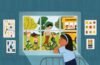





Being a Muslim and an artist are two things that go hand in hand for me. Becoming an artist has been a purposeful, intentional choice. Last year, I was commissioned by Factory International to research and develop an idea I’ve been exploring my entire life—experiencing my entire life, even. I decided to begin investigating what it means to be a Muslim woman in Britain’s current political climate and how Muslim women in the United Kingdom navigate these turbulent times. In the last fourteen years the political scope has plummeted into one that propagated the war on terror, conflating British Muslim identity with something fearful—the other and alien. We are paying the price of its impact in damaging ways, especially as Muslim women.
Therefore, I proposed this project hoping to create a narrative for myself and other Muslim women that belonged to us, first and foremost. This narrative would be led by us too, not by exoticized opinions that are often reductive and, far too often, not written by us. The white gaze others us in a precarious way, the harms of which have a lasting impact on how we are seen and interacted with, but there is never any accountability for it. We are expected to just exist, wholly as ourselves, continuing in our Muslimness with these treacherous misconceptions, discriminations, and outright misogynistic anti-Muslim rhetoric imposed on us. There is no manual directing us in negotiating how to successfully be in our light. So, I wanted to create a space in which Muslim women could safely begin discussing all of it. No gaze: just us, the trust between us, and lots of tea and snacks.
Therefore, I proposed this project hoping to create a narrative for myself and other Muslim women that belonged to us, first and foremost.
My project was to have discussions around planned activities that thematically surrounded the ideas of belonging, identity and home in relation to the provocation of creating a narrative. This consisted of two workshops I held in person and some closed conversations I had with Muslim women, some writing time to process my findings, and a closed sharing with my funders, peers, and some friends.
I began by inviting Muslim women of all ages and backgrounds to the workshop element I devised. I wanted the participants of my workshops to be diverse and include Muslim women from all walks of life. This included visibly Muslim women, those who do not look visibly Muslim, married, divorced, young, older, born Muslim women, reverts, South Asian, Middle Eastern and North African (MENA), East African, Eastern European—anyone who identified as a Muslim woman. I recorded the workshops I led, transcribed them, and later used this as a stimulus to write and respond to.

Golden Thread's First Decade
By Torange Yeghiazarian, Marina Johnson, Nabra Nelson. This episode is a deep dive into the founding of Golden Thread Productions...
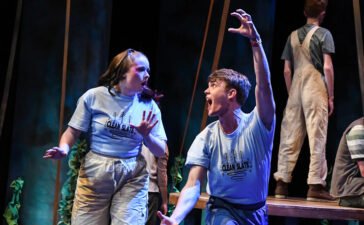
This Piece May Not Be Fed Into Any LLM or Other AI Software for Any Reason Whatsoever
By Kate Brennan, Rachel Anderson-Rabern, David Lee White. Technological innovation is outpacing labor protections, and theatre is not immune to...
A Conversation with Joey Arias
By Kristin Marting. On 6 April 2026, TORCHES continues with a conversation with the incomparable performance artist and cabaret singer...
Thirty Years of MENA Theatre
By Marina Johnson, Nabra Nelson. Marina and Nabra take a sweeping look at thirty years of Middle Eastern, North African,...


