




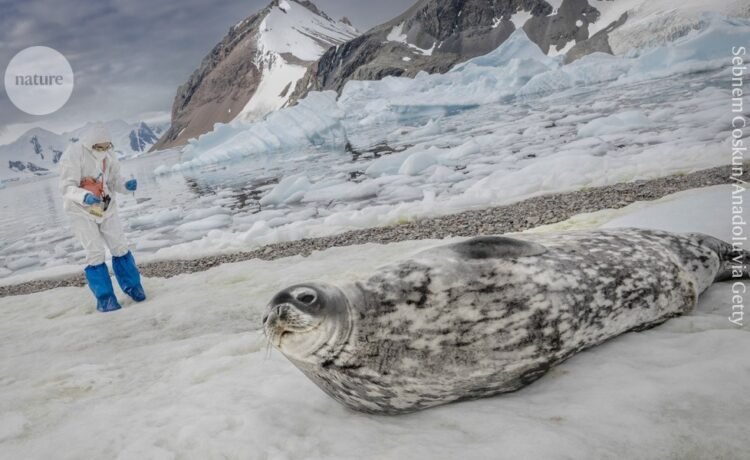
“In this image, I’m collecting faecal samples from Adélie penguins (Pygoscelis adeliae) on Horseshoe Island, off the Antarctic Peninsula at about 68° S. As an analytical chemist, my research focuses on detecting trace contaminants such as heavy metals, pesticides and microplastics.
It’s always been a dream of mine to travel to Antarctica, and I loved every minute. We follow strict rules to protect the wildlife, including wearing a protective suit. We also try to keep a distance from penguins and any other wildlife, such as the Weddell seal (Leptonychotes weddellii) that I’m pictured with, but some animals are naturally curious and difficult to avoid.
My university in Istanbul runs research trips to this site every year, coordinated by the Turkish government and Marmara Research Center in Gebze, Turkey. It’s a long journey from Istanbul — around 16,000 kilometres and ten days of travel. We first fly to Brazil, then to northern Chile, then down to Patagonia; finally we take a flight to South Georgia, from where we travel by boat.

The memory dealer of Old Jeddah
The holographic minaret of Al-Shafi’i drilled the Adhan straight into the mastoid bone behind my ear. A neural vibration, not...
Transposable elements are driving rapid adaptation of Enterococcus faecium
Bacterial genomic datasets compiled for this studySeveral bacterial genomic datasets were compiled for this study, and different selections of these...
Magnetic muon measurements and gene-therapy advances win US$3 million Breakthrough prizes
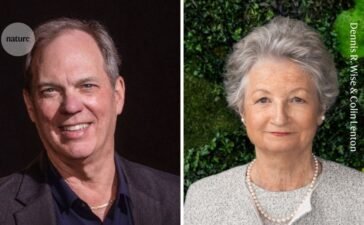
David Hertzog and Katherine High were among the winners of this year’s Breakthrough prize.Credit: Dennis R. Wise & Colin LentonResearchers...

light-sensitive cancer drugs win US$2 million contest
The winner of the Q4Bio US$2 million prize used the IBM Quantum System One computer, which is housed in the...


