




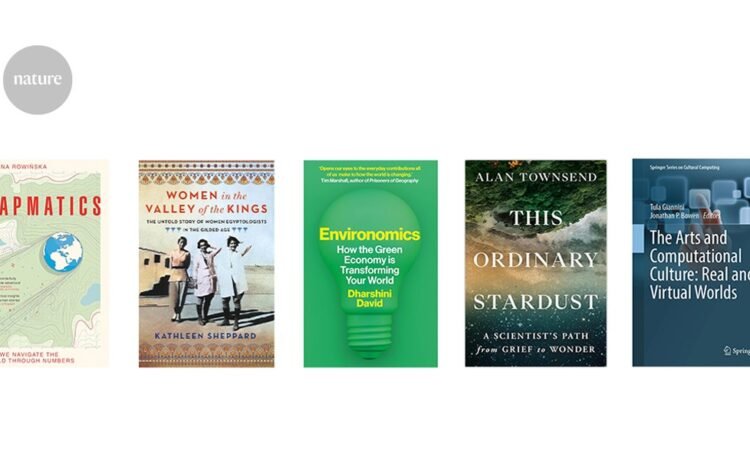

Environomics
Dharshini David Elliott & Thompson (2024)
Why should an orangutan care what toothpaste a person uses, asks economist Dharshini David, in her appealing book about how human lifestyle choices affect the planet. Answer: some toothpastes use palm oil to create foam, whereas others don’t, and palm-oil production requires the clearing of tropical forests, eliminating the habitats of creatures such as orangutans. “Nearly every issue that affects the environment comes down, in some way, to what someone, somewhere, is doing to make (or save) money,” she writes.

Mapmatics
Paulina Rowińska Picador (2024)
From world maps designed by geographer Gerardus Mercator for marine navigation in the sixteenth century to online maps created by Google for self-driving cars in the twenty-first century, maps rely on mathematics. “While different on the surface, the jobs of a mathematician and a cartographer are surprisingly similar,” writes mathematician Paulina Rowińska in her engaging and original history of ‘mapmatics’. Indeed, maps not only depend on mathematics but have also inspired many mathematical breakthroughs.

The Arts and Computational Culture
Eds Tula Giannini & Jonathan P. Bowen Springer (2024)
This substantial, topical collection on the arts and computing, edited by information scientist Tula Giannini and computer scientist Jonathan Bowen, begins with polymath Leonardo da Vinci’s blending of art and science and ends with a survey of modern art exhibitions that involve computing. As the editors write, “facilitated by computing, artificial intelligence, machine learning, algorithms, and simulated human senses, the arts are expanding their horizons”. Perhaps AI will eventually stand also for Artistic Imagination?

Women in the Valley of the Kings
Kathleen Sheppard St. Martin’s (2024)
Discussions of Egyptologists tend to focus on men — for example, Howard Carter, who excavated Tutankhamun’s tomb in 1922. Yet, women played an important part in Egyptology, as historian Kathleen Sheppard describes. She begins in the 1870s with Marianne Brocklehurst and Amelia Edwards’s A Thousand Miles up the Nile, and ends with Caroline Ransom Williams’s death in 1952. Lacking permission to find artefacts, these women “acquired, organized and maintained” the world’s largest collections of Egyptian objects.

This Ordinary Stardust
Alan Townsend Grand Central (2024)
Alan Townsend, dean of the college of forestry and conservation at the University of Montana in Missoula, calls himself a biogeochemist. This field can teach us, he remarks, about cornfields, fertilizers, lake colours, sea life and even planetary warming. It can also “nurture the soul”. He learnt this truth when both his beloved wife and four-year-old daughter fell ill with brain cancer, and only the child recovered. His moving memoir describes how scientific wonder rescued him from appalling grief and suicidal thoughts.
Competing Interests
The author declares no competing interests.


The ‘astounding’ rise of semaglutide — and what’s next for weight-loss drugs
First established as a treatment for diabetes, semaglutide’s popularity as a weight-loss drug has opened the door to new therapies.Credit:...
My mission to make life more user friendly for the disability community
Josh Miele explains the nuances of a tactile map of a Bay Area Rapid Transit station.Credit: Laurie UdeskyWorking scientist profilesThis...
US grant applicants surge at prestigious European research agency
Money could become harder to come by for European scientists if the overall European Research Council pot does not dramatically...
More than one-third of cancer cases are preventable, massive study finds
Tobacco smoking is a leading cause of preventable cancer cases.Credit: Jorge Sanz/SOPA Images/LightRocket/GettyNearly 40% of new cancer cases worldwide are...


