





Precise timekeeping helps us in our daily lives: from pinpointing your precise location with GPS to synchronising financial deals to the millisecond, and physicists are also seeking ever more accurate measurements of time, as super-accurate clocks could help make planet-sized telescopes, hunt for dark matter or even monitor the shape of the planet from the air.
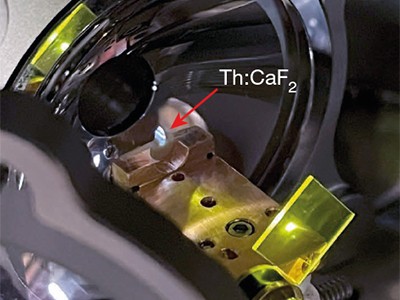
Read the paper: Frequency ratio of the 229mTh nuclear isomeric transition and the 87Sr atomic clock
So researchers are working on a nuclear clock – a device that would harness the energy levels of the nucleus of an atom to act as a timekeeper.
Now, they’ve got closer than ever, by making extremely accurate measurements of the frequency of light required to push thorium nuclei into a higher energy state – potentially defining the tick of a future nuclear clock.


Iranian scientists on losing labs, libraries and liberty
Sharif University of Technology after it was bombed on 7 April 2026.Credit: Fatemeh Bahrami/Anadolu via GettyBombs dropped by the United...

This organoid can menstruate — and shows how tissue can repair itself
Gynaecological disorders such as endometriosis could be studied using endometrium organoids.Credit: fizkes/ShutterstockResearchers have developed organoids that can regenerate like the...
what are they and what can they do?
Nvidia’s Cosmos is one world model being trained on physics data about real-world environments.Credit: NVIDIA CorporationAn ongoing trend in artificial...

The memory dealer of Old Jeddah
The holographic minaret of Al-Shafi’i drilled the Adhan straight into the mastoid bone behind my ear. A neural vibration, not...


