




Sophisticated spacecraft often run on shockingly outdated computing systems: consider that the Perseverance rover runs on a PowerPC 750, the processor famous for running on iMacs in the late 1990s.
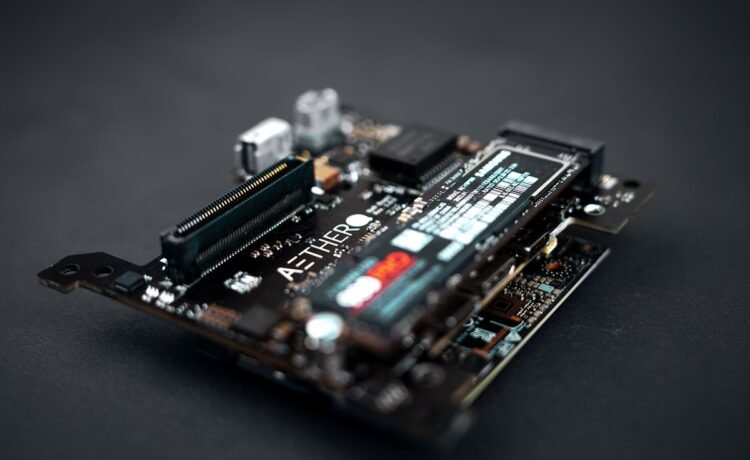
San Francisco-based Aethero is aiming to bring more powerful computing systems to orbit, and their first payload launches this month on SpaceX’s Transporter-11 rideshare mission. The computer, a small, stackable MVP called AetherNxN that’s built on an Nvidia Orin processor, will be getting extra protection from a new radiation shielding material that the product’s developers, Cosmic Shielding Corporation (CSC), say could help unlock a new era for computing in space.
Today, electronics in space are protected from harmful radiation in two ways. They’re physically shielded, using some combination of materials like aluminum and tantalum, and they’re radiation hardened, which generally means that they’re designed in ways that increase their tolerance to radiation exposure. The AetherNxN computer is rad-hardened, but adding CSC’s shielding “enables us to bring that AI-capable of hardware into space and have it operate under these very hostile conditions,” Aethero cofounder Edward Ge said in a recent interview.
CSC’s shielding is an new, 3D printed material that the company calls Plasteel (a term that goes back to Frank Herbert’s Dune): a polymer blend with a uniformly distributed layer of radiation-blocking nanoparticles. The company was founded in 2020 and has flown a its shielding material on missions with Axiom Space and Quantum Space. Plasteel is more flexible than aluminum, allowing it to be used for a wider variety of components — the company is even working on adapting it for space suits.
The company says that its material not only reduces the overall dose of radiation received by the computer, but is also more effective than traditional materials at limiting what’s known as “single event effects.” This is when a single ionizing particle, like a high energy proton, damages or otherwise affects an electronic circuit in space. (These events even occur on Earth, but it’s extremely rare because of the protection offered by the atmosphere.)

While reducing overall dose is important, mitigating single event effects is also vital. CSC co-founder and CEO Yanni Barghouty likened it to 100 tennis balls hitting a wall versus a single bullet; they may have the same total kinetic energy, but the latter is considerably more dangerous.
Both Ge and Barghouty agreed that next-generation shielding technologies will be needed to bring advanced, complex processors to space. Aethero anticipates its first and largest market being edge processing for Earth observation data — for instance, autonomously identifying interesting objects — but both companies see a new era of deep space exploration being enabled by advanced edge compute in space.
“Nothing this fast, from an AI standpoint, has ever been launched into space,” Barghouty said. “So having this work as it does is literally bringing Moore’s law into space.”


Chinese marketplace DHgate becomes a top US app as trade war intensifies
The Trump trade war has gone viral on TikTok, pushing a Chinese e-commerce app, DHgate, to the top of the...

Hertz says customers’ personal data and driver’s licenses stolen in data breach
Car rental giant Hertz has begun notifying its customers of a data breach that included their personal information and driver’s...

OpenAI plans to phase out GPT-4.5, its largest-ever AI model, from its API
OpenAI said on Monday that it would soon wind down the availability of GPT-4.5, its largest-ever AI model, via its...

Google’s newest AI model is designed to help study dolphin ‘speech’
Google’s AI research lab, Google DeepMind, says that it has created an AI model that can help decipher dolphin vocalizations,...


