




Hundreds Of Well-Preserved Submerged Ancient Roman Treasures Discovered At The Bottom Of Lake Neuchâtel

6Views
Jan Bartek – AncientPages.com – An underwater archaeological excavation is underway in Lake Neuchâtel, Switzerland, where the remains of a Roman cargo from a ship that sank nearly 2,000 years ago have been discovered. The wreck is dated between 20 and 50 AD and comes from a vessel that has long since disappeared.

Credit: Octopus Foundation
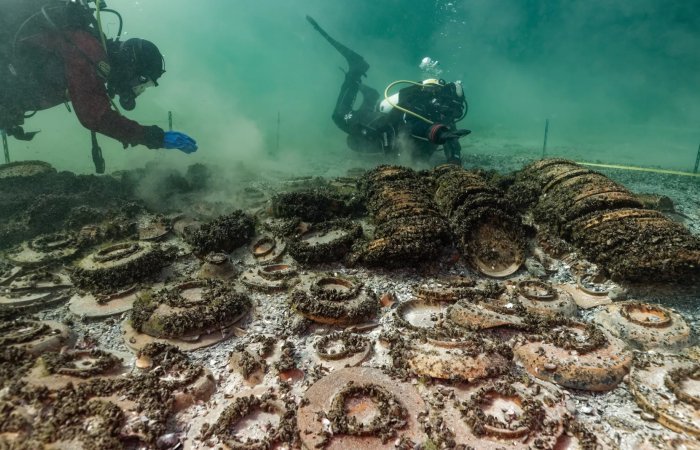
Since March 2025, the Cantonal Office of Archaeology of Neuchâtel (OARC), in collaboration with the Octopus Foundation and the Archaeological Service of the State of Fribourg (SAEF), has been conducting a systematic excavation. This work has led to the identification, documentation, and recovery of several hundred objects from the lakebed. The collection is notable for both its richness and diversity, and the excellent state of preservation of the artifacts makes this find exceptional in Switzerland and in inland waters north of the Alps.
An Exceptional Heritage At Risk
The cargo was first detected in November 2024 through aerial photography conducted as part of OARC’s routine monitoring of the lakebed and submerged cultural heritage. Following this discovery, exploratory dives and an initial excavation campaign began in March 2025 to evaluate the site’s potential and the challenges it presents, particularly regarding long-term preservation.

Credit: Octopus Foundation
Although the objects are currently well preserved, they are extremely fragile and face multiple threats, including erosion of the lakebed, damage from boat anchors, and the risk of vandalism and looting. To protect this heritage, archaeologists have adopted a preventive strategy: the most vulnerable items are carefully documented in situ and then systematically removed from the lake to reduce the risk of deterioration or loss.
Huge Well-Preserved Roman Cargo
The cargo recovered from the lake was both rich and diverse. It consisted mainly of several hundred ceramic vessels—dishes, plates, cups, and bowls—remarkably preserved intact on the lakebed. These items were produced at various sites across the Swiss Plateau, indicating a well-developed regional network of manufacture and distribution.

Credit: Octopus Foundation
In addition, amphorae used to transport olive oil and imported from Spain provide clear evidence of long-distance trade connections during the Roman period. Alongside these commercial goods, archaeologists also found everyday utensils and tools, offering insight into the daily activities and working conditions of the boatmen.
The discovery of harness and chariot components, including exceptionally well-preserved wheels, is particularly noteworthy. These are the only known Roman wheels of this type found in Switzerland and point to the use of a combined transport system integrating overland routes and lake navigation.
Finally, the presence of weapons—specifically swords—indicates that the ship, which sank between 20 and 50 AD, was likely a civilian merchant vessel traveling under military protection.

Credit: Octopus Foundation
The cargo’s rich and varied contents, all in excellent condition and well documented in their original context, offer an exceptional source of information. They create new opportunities for research on trade and exchange networks, technical skills and production methods, the identification of ceramic workshops, and the circulation and marketing of manufactured goods.
See also: More Archaeology News
In addition to specialized academic studies, it will be important to share the findings from this major discovery with a broader audience. One key way to do this will be through public display in the exhibition spaces of the Laténium, the archaeology park and museum of Neuchâtel.
Before any of this can happen, however, all objects must undergo careful handling and thorough conservation-restoration. This essential step is required to ensure both safe access to the artifacts and the environmental and sanitary conditions needed for their long-term preservation.
Source: République et Canton Neuchâtel
Written by Jan Bartek – AncientPages.com Staff Writer

Mythical Norse Artifacts Discovered In Viking Graves Confirm Icelandic Sagas Once Again
Ellen Lloyd - AncientPages.com - Archaeologists never truly know what they will uncover when they excavate Viking graves, or any...
2,400-Year-Old Underwater Structures Discovered Beneath Dicle Dam Lake In Türkiye
Jan Bartek - AncientPages.com - Historical structures estimated to be around 2,400 years old have been photographed underwater in the...

What They Never Told Us About Lullabies When We Were Children (Or Adults)
Conny Waters - AncientPages.com - Lullabies are gentle bedtime songs lovingly used to help children relax and drift into a...

Bertrand du Guesclin: ‘Eagle Of Brittany’ Brave, French Commander And His Clash With Sir Thomas Of Canterbury
A. Sutherland - AncientPages.com - Bertrand du Guesclin distinguished himself in the Hundred Years ' War, winning many victories and...


