




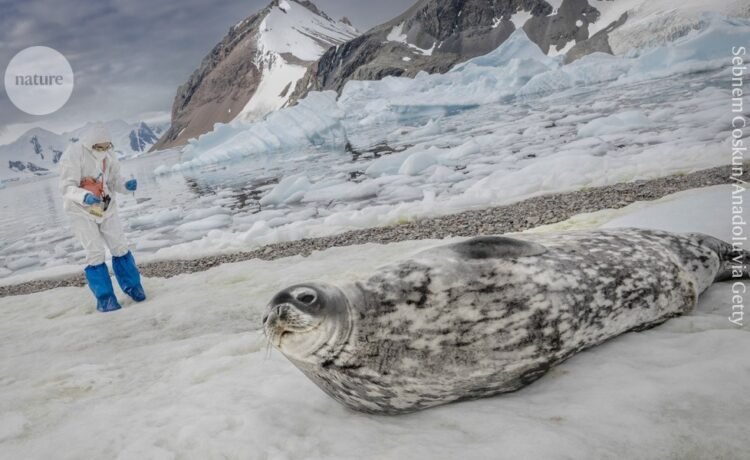
“In this image, I’m collecting faecal samples from Adélie penguins (Pygoscelis adeliae) on Horseshoe Island, off the Antarctic Peninsula at about 68° S. As an analytical chemist, my research focuses on detecting trace contaminants such as heavy metals, pesticides and microplastics.
It’s always been a dream of mine to travel to Antarctica, and I loved every minute. We follow strict rules to protect the wildlife, including wearing a protective suit. We also try to keep a distance from penguins and any other wildlife, such as the Weddell seal (Leptonychotes weddellii) that I’m pictured with, but some animals are naturally curious and difficult to avoid.
My university in Istanbul runs research trips to this site every year, coordinated by the Turkish government and Marmara Research Center in Gebze, Turkey. It’s a long journey from Istanbul — around 16,000 kilometres and ten days of travel. We first fly to Brazil, then to northern Chile, then down to Patagonia; finally we take a flight to South Georgia, from where we travel by boat.

What Artemis II’s astronauts will look for on the Moon’s far side
This Monday, 6 April, if all goes to plan, the astronauts aboard NASA’s Artemis II mission will fly around the...

Active dissociation of intracortical spiking and high gamma activity
Experimental procedures and approvalAll procedures were performed under protocols approved by the Northwestern University Institutional Animal Care and Use Committee....

Motherhood derails women’s academic careers — these data reveal how and why
After having their first child, women are 29% less likely to be employed at a university.Credit: miljko/GettyBecoming a parent is...
Why labs need a napping room to help you work, rest and play
Holly Newson 00:00 Welcome to Working Scientist, a Nature Careers podcast. I’m Holly Newson, and in this series, you’ll hear...


