




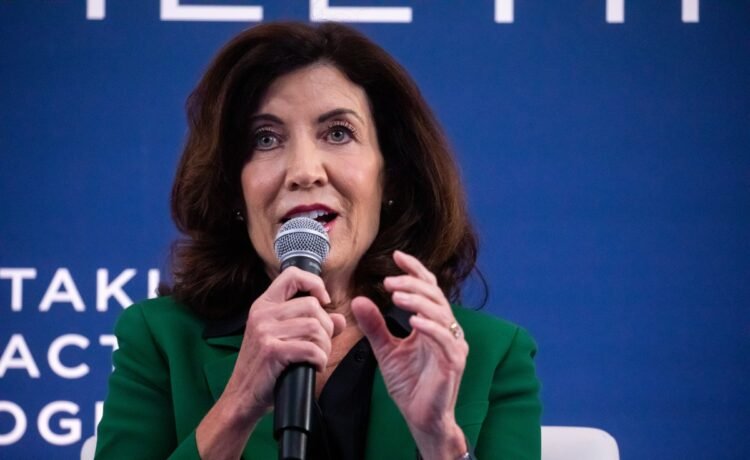
Governor Kathy Hochul has signed the RAISE Act, positioning New York as the second U.S. state to enact major AI safety legislation.
State lawmakers passed RAISE Act in June, but following lobbying from the tech industry, Hochul proposed changes to scale the bill back. The New York Times reports that Hochul ultimately agreed to sign the original bill, while lawmakers agreed to make her requested changes next year.
The bill will require large AI developers to publish information about their safety protocols and report safety incidents to the state within 72 hours. It will also create a new office within the Department of Financial Services to monitor AI development.
If companies fail to submit safety reports or make false statements, they can be fined up to $1 million ($3 million for subsequent violations).
California Governor Gavin Newsom signed a similar safety bill in September, which Hochul referenced in her announcement.
“This law builds on California’s recently adopted framework, creating a unified benchmark among the country’s leading tech states as the federal government lags behind, failing to implement common-sense regulations that protect the public,” Hochul said.
State Senator Andrew Gounardes, one of the bill’s sponsors, posted, “Big Tech thought they could weasel their way into killing our bill. We shut them down and passed the strongest AI safety law in the country.”
Techcrunch event
San Francisco
|
October 13-15, 2026
Both OpenAI and Anthropic expressed support for New York’s bill while also calling for federal legislation, with Anthropic’s head of external affairs Sarah Heck telling the NYT, “The fact that two of the largest states in the country have now enacted AI transparency legislation signals the critical importance of safety and should inspire Congress to build on them.”
Not everyone in the tech industry has been so supportive. In fact, a super PAC backed by Andreessen Horowitz and OpenAI President Greg Brockman is looking to challenge Assemblyman Alex Bores, who co-sponsored the bill with Gounardes. (Bores told journalists, “I appreciate how straightforward they’re being about it.”)
This comes after President Donald Trump signed an executive order that directs federal agencies to challenge state AI laws. The order — backed by Trump’s AI czar David Sacks — is the latest attempt by the Trump Administration to curtail states’ ability to regulate AI, and will likely be challenged in court.
We also discussed Trump’s executive order, and the role that Sacks and a16z have played in opposing state AI regulation, on the latest episode of the Equity podcast.


Thousands of rare concert recordings are landing on the Internet Archive — listen now
Chicago-based music superfan Aadam Jacobs has been recording the concerts he attends since the 1980s, amassing an archive of over...

Anthropic temporarily banned OpenClaw’s creator from accessing Claude
“Yeah folks, it’s gonna be harder in the future to ensure OpenClaw still works with Anthropic models,” OpenClaw creator Peter...

Iranian hackers are targeting American critical infrastructure, US agencies warn
The U.S. government is warning that Iran-backed hackers are escalating their tactics by targeting American critical infrastructure systems with the...

Anthropic says Claude Code subscribers will need to pay extra for OpenClaw usage
It’s about to become more expensive for Claude Code subscribers to use Anthropic’s coding assistant with OpenClaw and other third-party...


