




One atom, endless power: Scientists create a shape-shifting catalyst for green chemistry

96Views
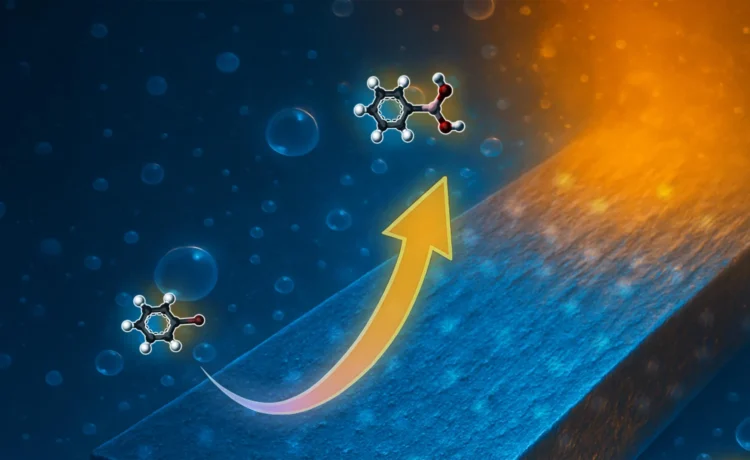
A research team at the Politecnico di Milano has developed an innovative single-atom catalyst capable of selectively adapting its chemical activity. This is a crucial step forward in sustainable chemistry and the design of more efficient and programmable industrial processes.
The study was published in the Journal of the American Chemical Society, one of the world’s most authoritative scientific journals in chemistry.
This achievement is a breakthrough in the field of single-atom catalysts. For the first time, scientists have demonstrated the possibility of designing a material that can selectively change its catalytic function depending on the chemical environment. It involves a sort of ‘molecular switch’ that allows complex reactions to be performed more cleanly and efficiently, using less energy than conventional processes.
The research focuses on a palladium-based catalyst in atomic form encapsulated in a specially designed organic structure. This structure allows the material to ‘switch’ between two key reactions in organic chemistry — bioreaction and carbon-carbon coupling — simply by varying the reaction conditions.
“We have created a system that can modulate catalytic reactivity in a controlled manner, paving the way for more intelligent, selective and sustainable chemical transformations,” explains Gianvito Vilé, lecturer in the ‘Giulio Natta’ Department of Chemistry, Materials and Chemical Engineering at the Politecnico di Milano and coordinator of the study.
In addition to its reaction flexibility, the new catalyst stands out for its stability, recyclability and reduced environmental impact. The ‘green’ analyses conducted by the team show a significant decrease in waste and hazardous reagents.
The study results from an international collaboration with the University of Milan-Bicocca, the University of Ostrava (Czech Republic), the University of Graz (Austria) and Kunsan National University (South Korea).

NASA Curiosity rover finds mysterious life linked molecules on Mars
NASA's Curiosity rover has identified a wide range of organic molecules on Mars, including compounds that scientists consider key ingredients...

Scientists just discovered Africa is closer to breaking apart than we thought
Eastern Africa's Turkana Rift is known both for its rich record of early human fossils and for intense volcanic activity...
Hidden virus in your gut may be linked to colon cancer
Colorectal cancer is among the most common cancers in Western countries and remains a major cause of cancer-related deaths. While...

A new force of nature is reshaping the planet, study finds
Human societies have not just adapted to the natural world. They have steadily learned how to transform it. Drawing on...


