




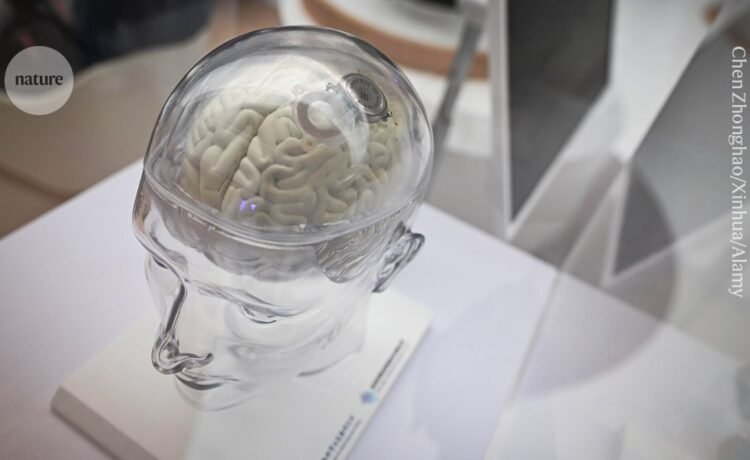
China has medical infrastructure and large population to test the efficacy of brain implants.Credit: Chen Zhonghao/Xinhua/Alamy
A deep brain device that allowed a man with no limbs to play computer games is one of an increasing number of brain–computer interfaces (BCI) being trialled in people in China.
The BCI system, developed by medical-technology company StairMed in Shanghai, China, is similar to the implants being trialled in people by Neuralink, owned by Elon Musk, based in Fremont, California. StairMed’s device has fewer probes than Neuralink’s device has, but is smaller and less invasive.
Compared with the United States, China doesn’t have the long history in the field, and many of the devices being trialled there are simplified versions of those developed by US companies, say researchers. But “BCI research in China is developing very fast”, says Zhengwu Liu, an electrical engineer at the University of Hong Kong.
Researchers in China are advancing the field on several fronts, such as by improving algorithms used to decode neural data and the implantation devices, says Christian Herff, a neural engineer at Maastricht University in the Netherlands, who co-organized a meeting on BCI in Shanghai last year.
The Chinese government has identified brain–computer systems as a priority area of innovation, and funding agencies are pouring money into the field. “A lot of young scientists are involved in this new wave of BCI,” in China, and have industry ties, says Yuanning Li, a computational neuroscientist at ShanghaiTech University.
The country also has the medical infrastructure and population to test and validate technologies, says Li. “Progress made here can benefit patients and researchers worldwide,” he says.
Several teams have announced initial results for early-stage trials, but none of these have been peer reviewed.
On the surface
One brain–computer device being trialled in people is a minimally invasive, wireless device called NEO, which can restore hand movement in a person with paralysis using a pneumatic glove. Eight probes are placed on the dura matter, the outer membrane surrounding the brain2.
The first person to receive the device, in October 2023, was able to strengthen and speed up their grip, and now, after living with the device for 20 months, can use it to eat and drink, says Hong Bo, a biomedical engineer at Tsinghua University in Beijing, who is co-leading the trial. Hong says that, so far, 20 individuals have received the NEO implant.
Because the technology collects information about a large population of cells, its signal resolution is not as strong as deeper probes that record the activity of individual neurons, says Zhengtuo Zhao, a neuroengineer at the Institute of Neuroscience, Chinese Academy of Sciences in Shanghai. This makes the approach more appropriate for controlling simple movements, he says. But Hong says the tradeoff in performance is that the device is minimally invasiveness and can run for a long time.
The NEO team has collaborated with Liu and his colleague Jianshi Tang, an electrical engineer at Tsinghua University. In a Nature Electronics paper in February1, they described the use of efficient neuromorphic chips, instead of conventional silicon chips, to mimic how the brain decodes brain signals. This would allow them to integrate the chip in the probe itself and make the device smaller, less power-hungry and quicker to process information.
Speaking Mandarin
Another team has dug slightly deeper into the brain. In July 2024, neurosurgeons in Shanghai implanted a device with 256 probes on top of the neural cortex of a woman with epilepsy. After two weeks of practice, she could use the device, designed by Shanghai-based BCI company NeuroXess, to use social-media applications and control a wheelchair.
Last December, the team surgically implanted probes into a woman with epilepsy who had a tumour in a part of her brain that processes language. The recipient used the device to communicate in Mandarin at a rate of 50 words per minute with a 100-millisecond delay — the first time that a BCI technology has been used to decode Mandarin in real time, says Tiger Tao, co-founder and chief scientist of NeuroXess. An average person can speak at a rate of 150 words a minute, so “there’s still a lot of room to improve”, he says.


Monthly HIV-drug injections offer potent alternative to daily tablets
Nature, Published online: 08 March 2026; doi:10.1038/d41586-026-00669-8Long-lasting treatment suppresses HIV in people with mental illness and other conditions that make...
High-rise transistors can be used to build space-saving circuits
NEWS AND VIEWS 05 March 2026 Logical circuits have been built from nanosheet stacks of various transistors, which could make...

meet the female colleagues who inspire these award-winning women in science
Science was once the domain of researchers toiling in solitude. Today, however, research thrives through collaboration, and is perhaps at...

what we do and don’t know
We are 23 of the 27 original members of the Scientific Advisory Group for the Origins of Novel Pathogens (SAGO)...


