




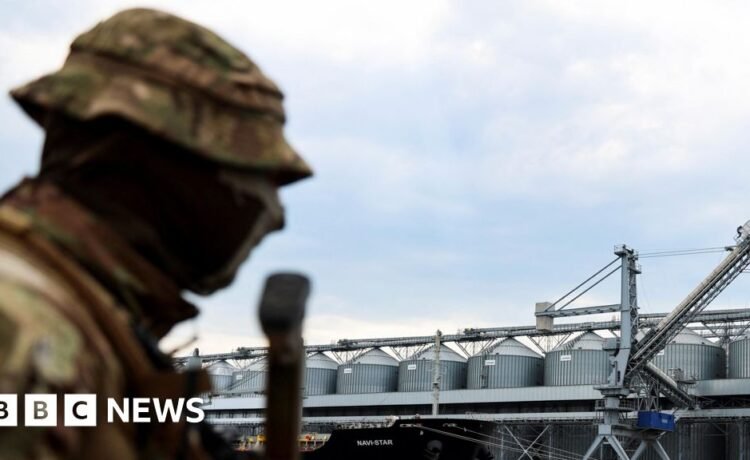
After three days of talks in Saudi Arabia, at last some progress.
Two separate texts outlining agreements between the US and Russia, and the US and Ukraine.
There were some differences but much was the same. All sides agreed to “to ensure safe navigation, eliminate the use of force, and prevent the use of commercial vessels for military purposes in the Black Sea”.
They also agreed “to develop measures for implementing… the agreement to ban strikes against energy facilities of Russia and Ukraine”.
President Zelensky regretted there was no explicit ban on attacks on civilian infrastructure but sounded broadly content.
He told reporters Ukraine would implement the Black Sea and energy ceasefires immediately.
He also got a nod to his agenda with the US saying that it would “remain committed to helping achieve the exchange of prisoners of war, the release of civilian detainees, and the return of forcibly transferred Ukrainian children”.
But then came a third document, issued by the Kremlin, which muddied the waters.
It imposed conditions that did not appear in the original agreement between the US and Russia.
It said the Black Sea ceasefire would come into force only when sanctions were lifted on Russian banks, insurers, companies, ports and ships that would allow it to export more agriculture and fertiliser goods.
In other words, they saw this deal not just as a revival of the old Black Sea Grain Initiative they pulled out of in 2023, but also an opportunity to roll back a significant number of economic sanctions.
However, doing this may take some time and thus delay any maritime ceasefire.
It also may not entirely be in the gift of the US to make all the changes Russia requested.
For example, any return to the SWIFT financial messaging system would require EU approval.
The Kremlin also said the 30-day pause on energy strikes would be back-dated to start on 18 March and could be suspended if one side violated the deal.
In other words, what has been agreed is a fragile step towards some diminution of the fighting in Ukraine but with no guarantee of success amid an atmosphere of mutual distrust.
Even if today’s agreement were to survive, it is still a long way from the comprehensive countrywide ceasefire the US originally wanted.
It is often said that ceasefires are processes, not events. And that is as true as ever for this agreement.
What matters is not the announcement of any ceasefire, but if and how it is implemented. In other words, the proof of the pudding will be in the eating.
Will both sides make this deal work and then live up to it? Because in the answer to those questions we will learn much about what both sides really want.
Do they want a ceasefire to turn into a longer-term peace? Or do they just want to trade while pressing home their advantage on the battlefield?


'I'd rather live in hiding in the US than return to Somalia'
Fear and uncertainty linger for Somali migrants in Minnesota despite a legal reprieve. Source link...

Beyonce, Rihanna and Katy Perry turn heads on the carpet
A parade of celebrities, including Naomi Osaka, Angela Bassett, Madonna, and Sabrina Carpenter posed for the cameras. Some famous faces...
Trump tells Congress ceasefire means he does not need their approval for Iran war
The president writes that hostilities "have terminated" because of the ceasefire, arguing he does not need congressional authorisation. Source link...
Former FBI director James Comey charged with threatening Trump’s life in Instagram post
"The DOJ will not be able to prove beyond a reasonable doubt that James Comey had the intent to threaten...


